

Case Study - Head of Transformation

Alan Herrity  | November 10, 2025

Case Study - Head of Transformation

Role

Head of Transformation.

Client Industry

Payments.

The Challenge

A rapidly scaling payments organisation had previously attempted to establish a transformation office without success. Momentum Search & Selection was engaged to diagnose why earlier efforts had failed and to lead a retained search to identify the right leader to deliver sustainable change.


The client required a transformation executive capable of embedding structure and governance while thriving in an agile, entrepreneurial environment — balancing strategic vision with delivery discipline.

Our Solution

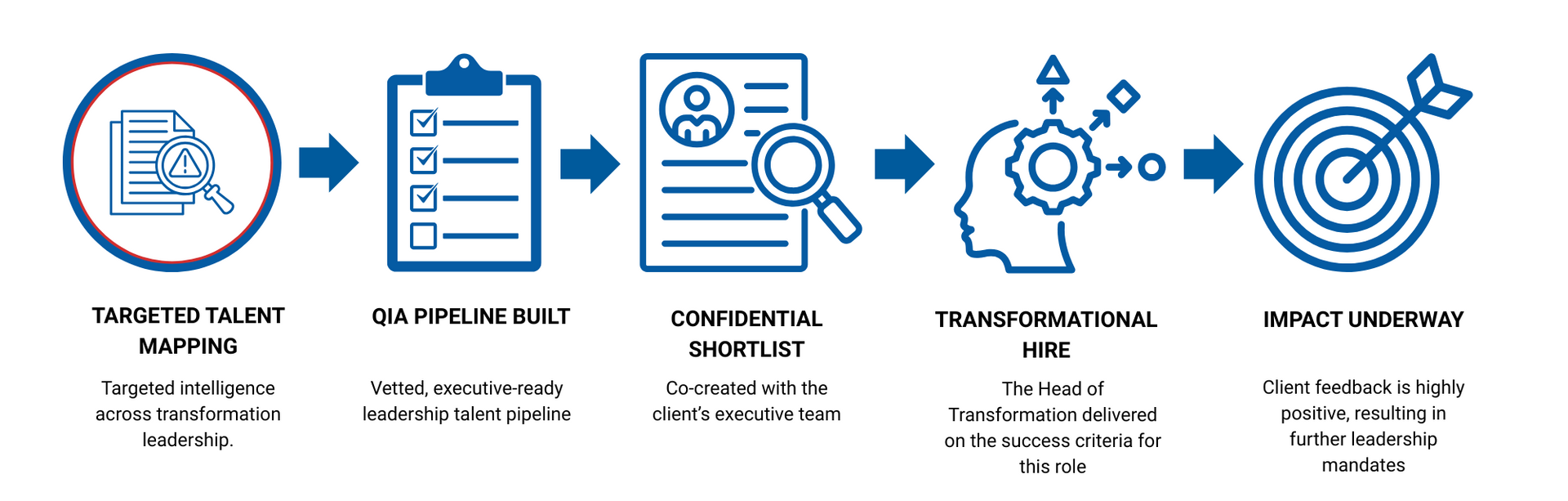
Momentum conducted a comprehensive targeted talent mapping exercise across the transformation leadership market. We identified executives with both enterprise-scale delivery experience and proven success in SME or start-up environments.


From this mapping, a Qualified, Interested, and Assessed (QIA) pipeline was developed — ensuring all candidates were leadership-ready, technically capable, and culturally aligned. Working in partnership with the client’s executive team, Momentum co-created a confidential shortlist of four outstanding candidates.


The appointed individual demonstrated exceptional transformation expertise, the agility to operate in a fast-growth environment, and the gravitas to influence at board level.

Securing Leadership to Sustain Organisational Transformation
The Result

The appointed Head of Transformation quickly delivered measurable organisational impact by:


  • Establishing a portfolio management framework aligned to strategic priorities.
  • Integrating an Agile Centre of Excellence with a traditional PMO.
  • Revising the project investment governance framework, improving transparency and decision-making.
  • Reducing staff attrition through enhanced leadership visibility and delivery confidence.
  • Successfully leading two major transformation programmes, central to the organisation’s growth trajectory.

Client Feedback

None applied for this case. The engagement highlights the critical importance of identifying candidates who have successfully operated within scale-up or start-up cultures — a key determinant of transformation success. Testimonial can be provided upon request.




Alan Herrity

Director, Momentum Search and Selection

0421 181 003

alan@momentumsearch.com.au


By Alan Herrity March 17, 2026
Case Study - Test Director - Core Banking Migration
By Alan Herrity March 17, 2026
Case Study - Process Architecture & Governance Leader
By Alan Herrity March 17, 2026
Case Study - PMO Director – Confidential Initiative
By Alan Herrity March 17, 2026
Case Study - Program Director – Core Banking & Operations
By Alan Herrity February 4, 2026
Case Study - Innovation and Accelerated Delivery Director
By Alan Herrity February 4, 2026
Case Study - Director - Enterprise Testing
By Alan Herrity February 4, 2026
Case Study - IT Director – Application and Technical Services
By Alan Herrity January 16, 2026
Case Study - Program Manager, Data Centre Exit Program
By Alan Herrity January 16, 2026
Case Study - Senior Manager, Enterprise Data
By Alan Herrity January 13, 2026
Appointing Interim Program Leaders Early Shapes Better Outcomes Organisations rarely struggle to agree which programs matter. Where they often struggle is deciding when to bring a senior delivery leader into the conversation. Recently, an Executive asked me for advice on how to structure and resource a critical program of work. The organisation is still at an early stage. The business case was being drafted, funding discussions were ongoing, and there was understandable desire to ensure success. The question wasn’t about whether leadership was required. It was about timing. My view was clear: the right Program Director should be involved as early as possible to help you shape success. The risk of waiting too long In some programs, senior delivery leadership is introduced once funding has been approved and the initiative is formally underway. By that point, key decisions have already been made. Assumptions have already been made; Timelines, budgets, and benefits are often framed around optimism rather than delivery reality. When a Program Director joins at that stage, they inherit constraints rather than help shape success Their role becomes one of mitigation rather than design. This is rarely intentional. It’s usually driven by a desire to control cost or avoid “over-engineering” too early. But in practice, delaying leadership often creates the very inefficiencies organisations are trying to avoid. What early hiring enables Bringing an experienced Program Director in early changes the nature of the conversation. Instead of planning in isolation, organisations benefit from delivery-informed thinking at the point where it matters most. At an early stage, the right interim leader can help: Shape a credible business case grounded in what is realistically deliverable. Clarify the level of funding required and the benefits that can genuinely be achieved within that investment Define the team, skills, and capability required to deliver, rather than retrofitting roles later and potentially blowing out budgets which were incorrect in the first place. Identify the organisational change impact early and work with the change practitioner/team to ensure success. Why interim leadership is often the right choice For many organisations, this level of program leadership capability doesn’t exist in-house, particularly for niche initiatives. Even where strong leaders are available, they are often already committed to existing priorities. Interim Program Directors offer a practical alternative. They bring a wealth of expertise, sector-specific experience, and the ability to operate independently of internal politics. Importantly, they can focus on setting the program up for success without the land and expand model of the consultancy world. Used well, interim leadership at this stage is not an added cost. It is an investment in clarity, realism, and better decision-making. Shifting the mindset The organisations that consistently deliver complex programs well tend to share one characteristic. They involve delivery expertise early, before plans become fixed and difficult to challenge. They treat program leadership as a strategic design input, not just a delivery function. That shift in mindset often determines whether a program starts with momentum or spends its early phases recovering from avoidable missteps. A question worth considering If you’ve been involved in shaping or sponsoring major programs, you’ll likely have seen both approaches in action. When have you seen prompt hiring of an Interim Program Director materially improve the outcome of a program? And where has waiting too long made recovery harder than it needed to be? Those experiences are often where the most valuable lessons sit. Please contact Alan Herrity to explore this topic further.