Case Study - Test Director – Core Banking Migration

Alan Herrity  | March 17, 2026

Case Study - Test Director - Core Banking Migration

People in a meeting room, one presenting at a whiteboard, others at a table.

Role

Test Director – Core Banking Migration

Client Industry

Banking.

The Challenge

A leading Banking organisation was undertaking a large-scale core banking systems migration Program that had begun to stall.


The Program lacked the specialist testing leadership capability required to ensure that the program will be delivered successfully.


The organisation required an experienced Test Director who could quickly take ownership of the testing strategy and ensure the migration Program regained momentum.

Our Solution

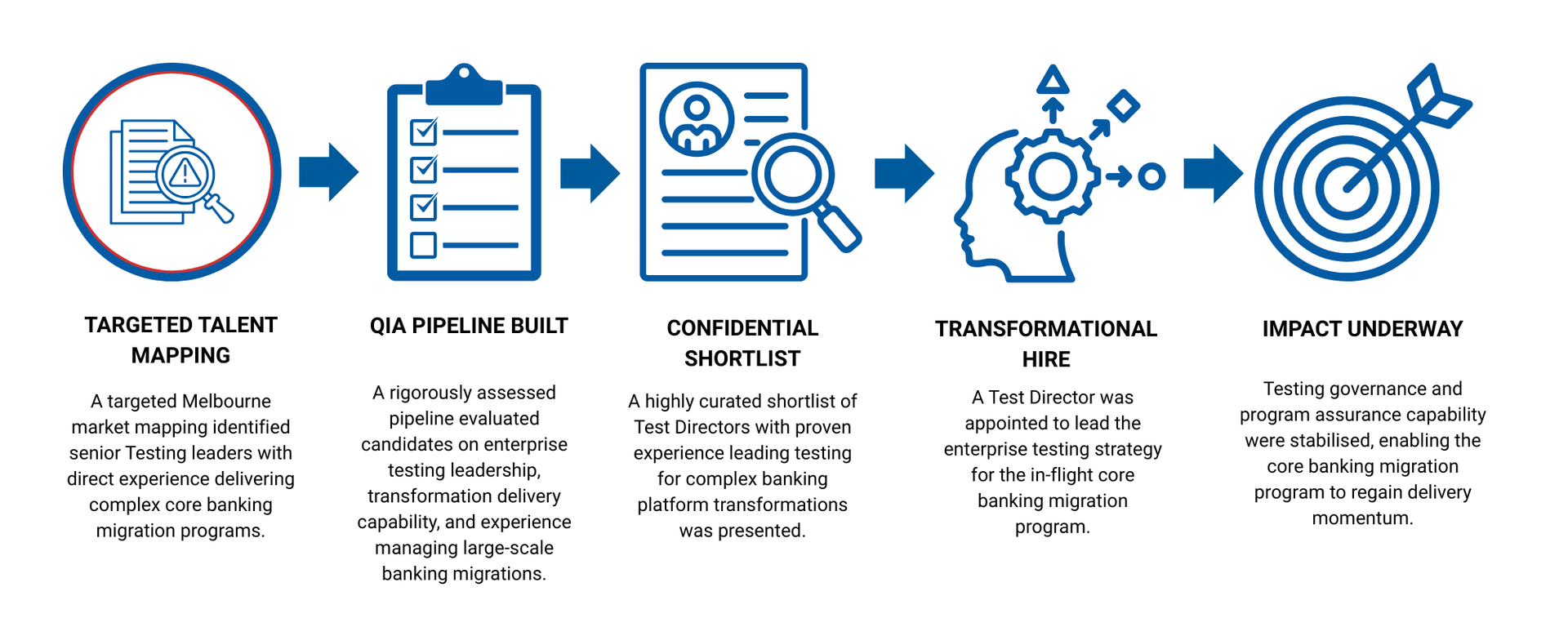
Momentum Search & Selection partnered closely with the Program Executive to deliver a targeted, insight-led retained search focused on identifying senior Testing leaders with direct core banking migration experience.


Our approach included:


  • A comprehensive Melbourne market search focused on Test Directors with proven experience delivering complex core banking platform migrations.
  • Rigorous candidate assessment, ensuring alignment across technical capability, leadership style and Program delivery track record.
  • Presentation of a high-quality, fully assessed shortlist of interested and qualified candidates.


Stabilising a Critical Core Banking Transformation through Expert Testing Leadership

Process for identifying talent, from portfolio to impact.

The Result

Despite a limited talent pool, three highly qualified candidates were shortlisted and interviewed.


This resulted in the successful appointment of a Test Director to lead the testing function for the in-flight Program.


The appointment provided the leadership capability required to stabilise and progress the core banking migration, positioning the Program for successful delivery.


Following this successful appointment, the client engaged Momentum Search & Selection for further confidential Executive Searches under non-disclosure agreements, reinforcing confidence in both the outcome and the partnership.


Alan Herrity

Director, Momentum Search and Selection

0421 181 003

alan@momentumsearch.com.au


By Alan Herrity March 17, 2026
Case Study - Process Architecture & Governance Leader
By Alan Herrity March 17, 2026
Case Study - PMO Director – Confidential Initiative
By Alan Herrity March 17, 2026
Case Study - Program Director – Core Banking & Operations
By Alan Herrity February 4, 2026
Case Study - Innovation and Accelerated Delivery Director
By Alan Herrity February 4, 2026
Case Study - Director - Enterprise Testing
By Alan Herrity February 4, 2026
Case Study - IT Director – Application and Technical Services
By Alan Herrity January 16, 2026
Case Study - Program Manager, Data Centre Exit Program
By Alan Herrity January 16, 2026
Case Study - Senior Manager, Enterprise Data
By Alan Herrity January 13, 2026
Appointing Interim Program Leaders Early Shapes Better Outcomes Organisations rarely struggle to agree which programs matter. Where they often struggle is deciding when to bring a senior delivery leader into the conversation. Recently, an Executive asked me for advice on how to structure and resource a critical program of work. The organisation is still at an early stage. The business case was being drafted, funding discussions were ongoing, and there was understandable desire to ensure success. The question wasn’t about whether leadership was required. It was about timing. My view was clear: the right Program Director should be involved as early as possible to help you shape success. The risk of waiting too long In some programs, senior delivery leadership is introduced once funding has been approved and the initiative is formally underway. By that point, key decisions have already been made. Assumptions have already been made; Timelines, budgets, and benefits are often framed around optimism rather than delivery reality. When a Program Director joins at that stage, they inherit constraints rather than help shape success Their role becomes one of mitigation rather than design. This is rarely intentional. It’s usually driven by a desire to control cost or avoid “over-engineering” too early. But in practice, delaying leadership often creates the very inefficiencies organisations are trying to avoid. What early hiring enables Bringing an experienced Program Director in early changes the nature of the conversation. Instead of planning in isolation, organisations benefit from delivery-informed thinking at the point where it matters most. At an early stage, the right interim leader can help: Shape a credible business case grounded in what is realistically deliverable. Clarify the level of funding required and the benefits that can genuinely be achieved within that investment Define the team, skills, and capability required to deliver, rather than retrofitting roles later and potentially blowing out budgets which were incorrect in the first place. Identify the organisational change impact early and work with the change practitioner/team to ensure success. Why interim leadership is often the right choice For many organisations, this level of program leadership capability doesn’t exist in-house, particularly for niche initiatives. Even where strong leaders are available, they are often already committed to existing priorities. Interim Program Directors offer a practical alternative. They bring a wealth of expertise, sector-specific experience, and the ability to operate independently of internal politics. Importantly, they can focus on setting the program up for success without the land and expand model of the consultancy world. Used well, interim leadership at this stage is not an added cost. It is an investment in clarity, realism, and better decision-making. Shifting the mindset The organisations that consistently deliver complex programs well tend to share one characteristic. They involve delivery expertise early, before plans become fixed and difficult to challenge. They treat program leadership as a strategic design input, not just a delivery function. That shift in mindset often determines whether a program starts with momentum or spends its early phases recovering from avoidable missteps. A question worth considering If you’ve been involved in shaping or sponsoring major programs, you’ll likely have seen both approaches in action. When have you seen prompt hiring of an Interim Program Director materially improve the outcome of a program? And where has waiting too long made recovery harder than it needed to be? Those experiences are often where the most valuable lessons sit. Please contact Alan Herrity to explore this topic further.

By Alan Herrity January 13, 2026
Why detailed assessment and candidate preparation is key to success Every so often, a comment from a candidate makes you pause. Recently, a Transformation Executive said something which made me proud. “I’ve worked with a lot of search firms. You’re the most thorough person who’s ever represented me.” A moment later, they added: “I’ve never been prepared for an interview in the way you prepare your candidates.” It’s always good to receive this kind of feedback, but it also reinforces something I’ve believed throughout my career: preparation isn’t a nice-to-have in Executive Search. It is fundamental to producing strong outcomes for both clients and candidates. What “thorough” really means At Momentum Search, our work is built on a simple premise: A successful search depends on the clarity of the brief, the rigour of the assessment, and the level of preparation given to every candidate we put forward. To do that well, we focus on two types of competency. Functional competencies These are the capabilities required to do the job – the technical skills, experience and executional ability. Years of service or industry background can provide useful context, but they’re not competencies. We look for evidence of what someone has actually delivered. Behavioural competencies This is how a leader operates: their judgement, resilience, communication style, and ability to lead through ambiguity. In many cases, these behaviours determine whether someone, will not only succeed in a role, but positively shape the organisation. How we assess candidates We test both competency sets at three points in the process: An initial call to understand the individual and set expectations. A structured, evidence-led interview - virtual or in person. Comprehensive preparation before any client meeting. At each stage, we’re looking for alignment to the brief, not a polished performance. Candidates deserve support - but they must also be challenged. Getting that balance right is part of the craft. A straightforward philosophy Our approach doesn’t need to be complex. We find the strongest talent available. We test and prepare them properly. We help them perform at their best for our clients We build long-term partnerships on the back of consistent delivery.  When clients and candidates allow us to be thorough, the search process becomes clearer, faster, and more reliable. Everyone benefits from a higher standard. Preparation isn’t our differentiator. It’s the foundation of everything we do. Please contact Alan Herrity to explore this topic further.